

A car diffuser that empties unusually fast is not always evaporating too quickly. It may be leaking, releasing too much fragrance through its wick or vent, or losing liquid faster in a hot vehicle. The best fix depends on which of those problems is happening.
Start here: inspect the bottle and surrounding surfaces for leaks, check whether the diffuser is exposed to direct sunlight or strong vent airflow, and review the manufacturer’s instructions before changing the refill or opening size.
1. First, Check Whether It Is Leaking
Evaporation normally causes a gradual loss of fragrance without obvious liquid residue. Leakage often leaves a different trail:
- Oily marks around the cap, stopper, wick, or bottle neck
- A wet wooden lid or saturated hanging cord
- Drops on the dashboard, console, or packaging
- An unexpected drop in liquid level after the bottle tips or swings
If you find any of these signs, stop using the diffuser until the problem is resolved. Fragrance liquid can stain or damage some plastics, leather, painted finishes, and trim. Follow the vehicle manufacturer’s guidance for cleaning affected surfaces. Do not leave a leaking bottle inside the car.
For hanging glass bottles, check that the stopper and cap are used exactly as directed. Some designs require briefly tipping the bottle to wet a wooden cap; others use a wick or membrane and must not be tipped. Never assume the instructions are interchangeable.
2. Heat and Sunlight Can Increase Fragrance Loss
Heat generally makes volatile fragrance ingredients evaporate faster. A diffuser next to a sunlit windshield or hot dashboard may release fragrance differently from the same unit in a shaded, climate-controlled position.
This explains why a car diffuser may seem to last longer in cooler weather and empty more quickly during summer. However, there is no dependable ‘days of use’ figure without knowing the formula, diffuser design, and actual conditions.
What to do:
- Keep the diffuser out of prolonged direct sunlight and extreme heat, following its product instructions.
- Avoid resting liquid diffusers directly on hot dashboards or finished surfaces.
- Remove or safely store the unit when the manufacturer recommends doing so in very hot conditions.
- Never leave open refill bottles in the car.
3. Direct Airflow and Exposed Surface Area Matter
A vent-mounted diffuser can release fragrance faster when heated or subjected to strong moving air. The specific effect depends on how the device works: a liquid wick, absorbent pad, membrane, gel, or electronically controlled cartridge will not respond in exactly the same way.
Other design choices also matter. A wider opening or larger exposed pad can allow more fragrance to escape. Some hanging-bottle designs release too much liquid when their wooden caps are repeatedly oversaturated.
To reduce unnecessary loss, use the product’s adjustable setting if it has one, follow its recommended vent position, and avoid repeatedly tipping or soaking an absorbent cap. Do not block vehicle ventilation or place an accessory where it could obstruct the driver’s view or controls.
4. The Fragrance Formula and Diffuser Base Affect Longevity
A car diffuser contains more than a pleasant fragrance. Its carrier or base, fragrance composition, wick or membrane, and housing work together to control release.
More volatile materials may produce a noticeable initial scent but can disappear relatively quickly. A slower-releasing base may last longer, yet it can also give a weaker scent or work poorly with certain wicks. Adding more fragrance does not automatically fix a short lifespan.
For a product-development team, the useful question is not simply ‘Which oil lasts longest?’ It is which complete formula and diffuser design gives a consistent scent without leakage, surface damage, or unacceptable rapid loss? The correct answer requires testing the finished product.
5. Different Car Diffuser Formats Behave Differently
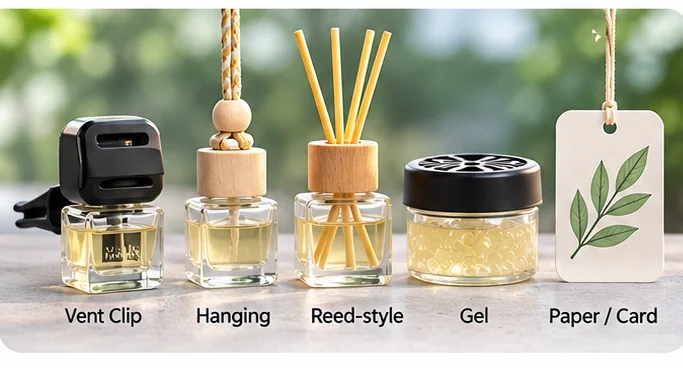
| Diffuser format | Main release mechanism | What may shorten its usable life |
|---|---|---|
| Vent clip with liquid wick | Wick plus airflow | Strong vent airflow, heat, poor seals |
| Hanging bottle with wooden cap | Liquid absorbed by cap | Repeated tipping, oversaturation, leakage |
| Scented paper or card | Evaporation from exposed material | Large exposed area, heat, sunlight |
| Gel or solid diffuser | Release from gel or solid matrix | Heat and product-specific exposure conditions |
| Electronic cartridge diffuser | Controlled or powered release | High output setting, frequent operation, cartridge design |
These are design considerations, not a ranking of which format lasts longest. Fill size, chemistry, placement, and usage differ too much for a fair universal comparison. Explore the available car diffuser formats to identify a format suitable for your intended use.
6. A Simple Test to Identify the Cause
If two units of the same model and refill behave differently, compare them under controlled conditions before deciding that the fragrance is faulty.
- Check both units for leakage, damaged seals, and incorrect installation.
- Record each unit’s starting weight using a sufficiently precise scale, if practical. Do not remove liquid or alter its opening just to weigh it.
- Note the mounting position, exposure to sunlight, temperature, fan setting, and hours of use.
- Weigh or inspect the units at consistent intervals while keeping the test conditions as similar as possible.
- Record scent intensity separately from liquid loss. A weak-smelling diffuser is not necessarily losing liquid quickly.
| Observation | More likely explanation | Next check |
|---|---|---|
| Rapid liquid loss with oily residue | Leakage or oversaturation | Seal, cap, stopper, mounting angle |
| Rapid loss mainly on hot days | Heat-sensitive release | Sun exposure and storage instructions |
| Fast loss near a strong vent | Airflow or heater exposure | Vent setting and product placement |
| Liquid remains but scent seems weak | Release or scent-perception problem | Wick, cartridge, fragrance character |
| Consistently short life in multiple controlled tests | Formula or product-design mismatch | Finished-product performance testing |
For brands comparing several formulas, change one variable at a time and record mass loss and scent performance together. A single short drive is not enough to substantiate a product-longevity claim.
7. How to Make a Car Diffuser Last Longer
The most effective fixes are usually simple:
- Use it as designed. Follow the instructions for tipping, refilling, closing, and mounting the diffuser.
- Avoid prolonged heat exposure. Do not leave it in direct sunlight or on a hot dashboard when the instructions warn against doing so.
- Control its release setting. Reduce the opening or output only if the device provides that adjustment.
- Prevent oversaturation. A soaked wooden cap or pad can cause mess and leakage rather than better controlled scent.
- Use compatible refills. Do not add water, alcohol, or carrier oils unless the manufacturer explicitly approves them.
- Replace damaged components. A cracked bottle or defective cap is not a formulation problem that can be solved by reducing airflow.
Frequently Asked Questions
Why does my car diffuser run out faster in summer?
Higher temperatures and direct sunlight can speed up fragrance release. Check placement and the manufacturer’s heat-related storage guidance before changing the formula.
Is a strong smell proof that the diffuser is evaporating too quickly?
No. Fragrance composition, human scent perception, and release rate all affect what you smell. Compare actual liquid loss rather than relying only on scent intensity.
Can I add water or another oil to slow evaporation?
Not unless the manufacturer specifically permits it. Unapproved liquids can affect wicking, fragrance performance, material compatibility, and safety.
How can I tell the difference between evaporation and leakage?
Normal evaporation generally lowers the liquid level gradually without leaving oily marks. Wet packaging, stained trim, drips, or an unusually saturated cap are warning signs of leakage or oversaturation.
How long should a car diffuser last?
There is no reliable universal answer. Duration depends on the fill size, fragrance base, diffuser mechanism, heat, airflow, and operating schedule. Compare the product with a clearly defined manufacturer’s claim or a controlled test of the same model.
Final Takeaway
A car diffuser that empties too quickly may be affected by heat, airflow, formulation, or product design—but leakage should be ruled out first. Use the diffuser according to its instructions, avoid unnecessary heat exposure, and judge performance by both fragrance release and actual liquid loss.
If you are developing a private-label car fragrance product, contact YouranCrafts to discuss diffuser formats and the performance requirements for your project.