

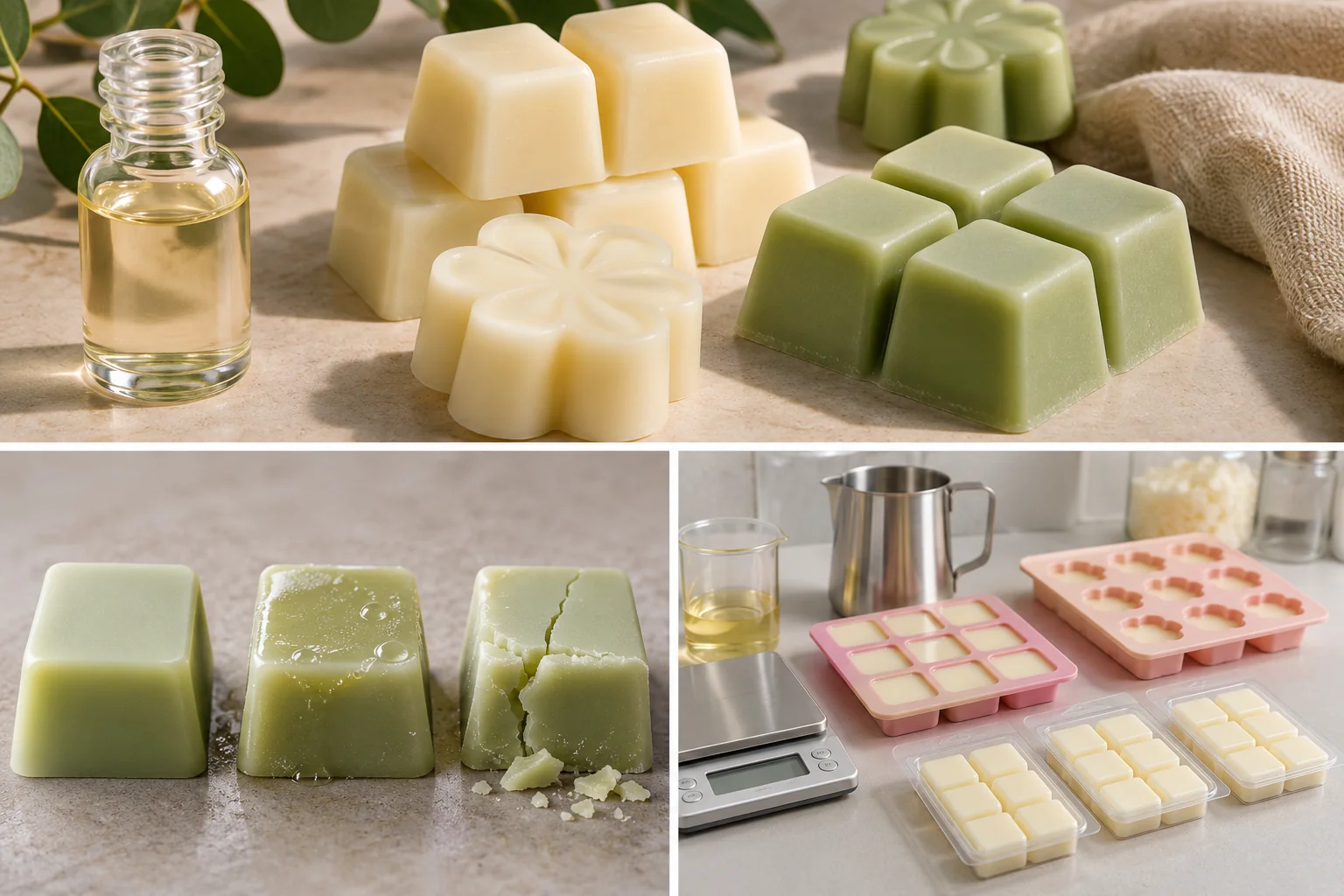
Fragrance oil influences more than how a wax melt smells. It can change the way the wax sets, how firm the finished melt feels, whether oil appears on its surface, and how easily it releases from a mold or clamshell. But a sticky or cracked melt does not automatically mean it contains too much fragrance: wax composition, fragrance compatibility, cooling, and storage also matter.
This guide explains how to calculate fragrance load, recognize common texture problems, and compare formulas without changing several variables at once.
What Is Fragrance Load?
Fragrance load is the amount of fragrance oil in a formula, expressed as a percentage. Always check what the percentage is based on. Two common calculations are:
- Percentage of wax weight: fragrance oil ÷ wax weight × 100
- Percentage of finished formula: fragrance oil ÷ (wax weight + fragrance oil) × 100
For example, adding 8 g of fragrance oil to 100 g of wax produces:
| Measurement | Calculation | Result |
|---|---|---|
| Load based on wax weight | 8 ÷ 100 × 100 | 8.00% |
| Load based on finished weight | 8 ÷ 108 × 100 | 7.41% |
Both figures describe the same batch. They are not interchangeable when comparing formulas or checking supplier limits. Record the calculation basis alongside every fragrance-load percentage.
The appropriate load depends on the exact wax blend and fragrance. A supplier’s maximum is not a target: a formula may perform better at a lower level. Check the wax manufacturer’s instructions and the fragrance supplier’s application-specific documentation before testing.
Why More Fragrance Can Change Texture
As wax cools and solidifies, it forms a structure that must retain the added fragrance oil. Some fragrance systems soften the finished wax or interact poorly with a particular blend. If the formula cannot retain the oil under its production and storage conditions, the melt may become tacky or develop visible surface oil.
Increasing fragrance load can also affect firmness, breakage, and mold release. However, the result is not universal: two fragrance oils used at the same percentage can behave differently in the same wax. A high percentage does not guarantee stronger scent performance, either.
The main variables are:
- Wax blend: Different blends vary in firmness, crystallization, and fragrance compatibility.
- Fragrance composition: Different oils can change setting behavior and surface feel even at identical loads.
- Mixing conditions: Incorrect addition temperature or insufficient mixing can produce inconsistent batches. Use the suppliers’ instructions rather than a universal temperature.
- Cooling: Drafts, uneven temperature, or premature demolding can contribute to cracking or distortion.
- Packaging and storage: Heat can reveal softness, oil migration, and sticking that were not obvious immediately after pouring.
Common Wax Melt Texture Problems
| Symptom | Possible causes | First checks |
|---|---|---|
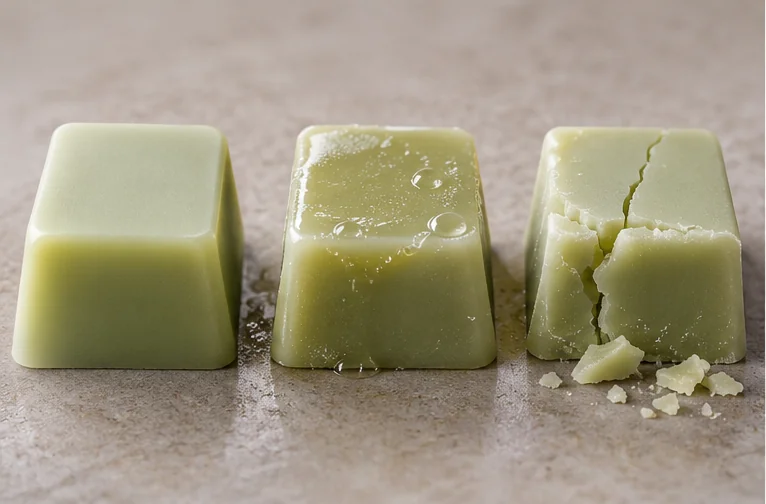
| Soft or tacky surface | High load for that wax-fragrance combination; inherently soft wax; warm storage | Compare a lower-load control and check storage conditions |
| Oil droplets or greasy film | Fragrance migration or incompatibility; heat exposure | Verify dosing, supplier guidance, and oil migration after storage |
| Cracking or shrinkage | Cooling stress, mold geometry, demolding timing, wax formulation | Compare cooling conditions before blaming fragrance load |
| Brittle or crumbly melts | Wax blend, cooling, formulation balance | Compare unscented and scented controls, then investigate the wax blend |
| Sticking to a clamshell | Soft surface, surface oil, package interaction | Test release after conditioning and after warm storage |
| Uneven or mottled finish | Wax crystallization, mixing, cooling, additives | Standardize the process and compare samples under the same conditions |
Important: Frosting, cracking, and crumbling are not reliable proof of fragrance overloading. Change one factor at a time before drawing that conclusion.
How to Test Fragrance Load Properly
1. Establish a baseline
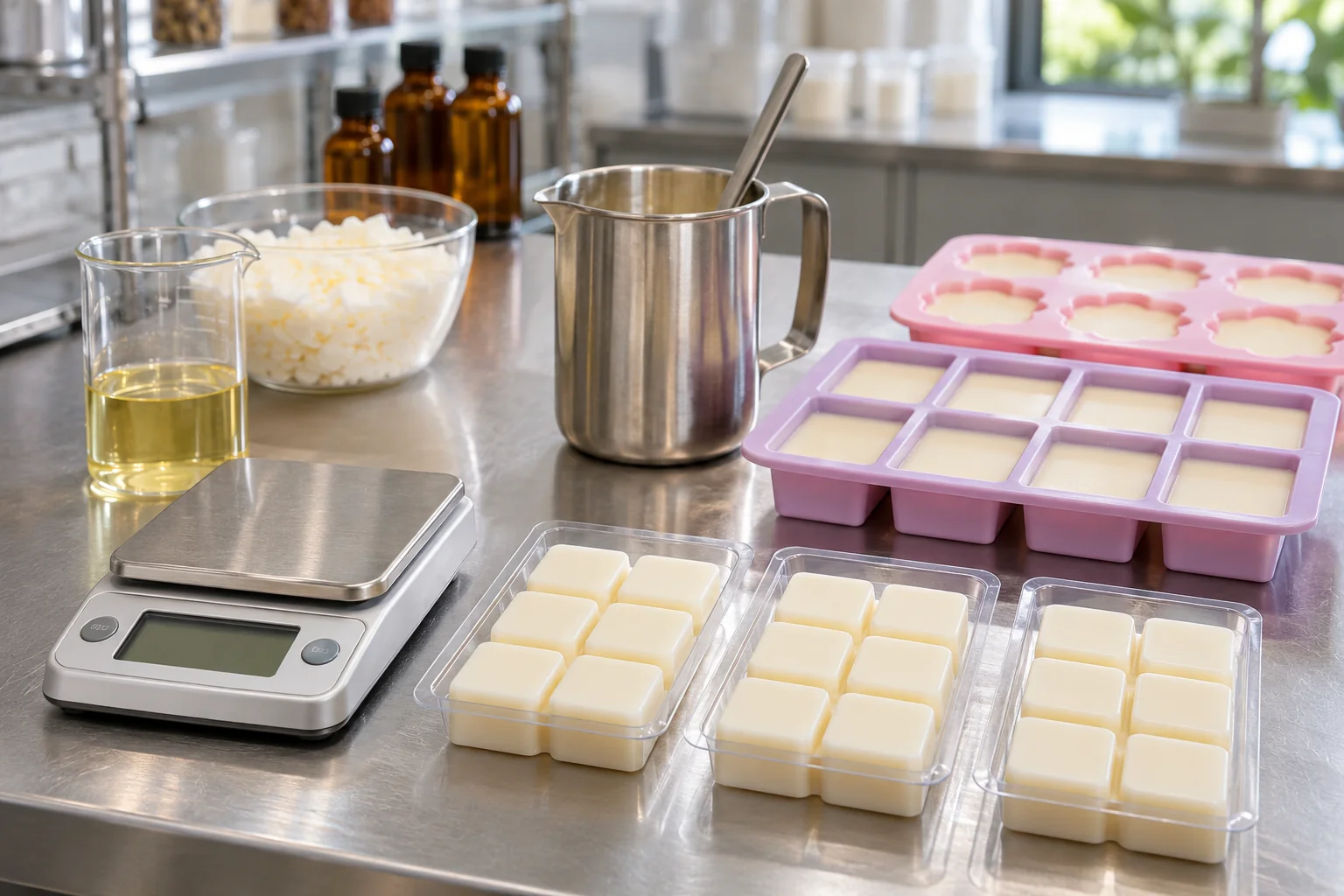
Choose one wax batch, one fragrance, one mold or package, and one production method. Record the wax and fragrance weights, addition temperature, mixing time, pour conditions, cooling conditions, and storage conditions. Keep dye and additives consistent or leave them out for the initial comparison.
2. Make a controlled load ladder
Test a baseline and one or two nearby load levels only if all levels comply with the relevant supplier and application limits. The following is an illustrative worksheet, not a recommended recipe or a universal safe range:
| Sample | Wax | Fragrance (wax-weight basis) | Finished batch |
|---|---|---|---|
| A | 100 g | 6 g (6%) | 106 g |
| B | 100 g | 8 g (8%) | 108 g |
| C | 100 g | 10 g (10%) | 110 g |
Use these numbers only where the particular wax and fragrance allow them. If your verified limits are lower, choose lower test points.
3. Compare at the same checkpoints
Inspect each sample after it has fully set, after the supplier-recommended conditioning or cure period, and after defined storage tests. Use identical conditions and log:
- Surface appearance and touch: dry, tacky, or visibly oily
- Firmness and tendency to chip or crumble
- Ease of demolding or removal from clamshell packaging
- Cracks, shrinkage, deformation, or oil migration
- Cold scent and warmed scent performance, evaluated consistently
For warm-storage testing, set conditions suitable for the product’s expected shipping and retail environment; do not invent a universal temperature or duration. Keep a control sample at ordinary storage conditions for comparison. Do not sell or distribute samples that fail applicable safety or quality checks.
4. Choose a balanced formula
Select the load that meets the product’s scent, texture, packaging, storage, safety, and cost requirements—not simply the highest number that can be mixed into the wax. If several loads pass, the lower one may be the more economical and robust option.
How to Prevent Texture Problems
Start with the wax supplier’s recommended range and confirm that the fragrance is suitable for wax melts. Weigh fragrance by mass rather than estimating by drops or volume. Follow the specified fragrance-addition and pouring instructions, and keep cooling conditions consistent.
Before approving a formula for production, test it in its actual retail packaging. A melt that releases well from a silicone mold may still stick to a clamshell after warm storage. Keep labeled retention samples so later batches can be compared with an approved reference.
If texture changes between batches, check the weighing records, supplier batch details, mixing process, cooling, and storage before changing the fragrance load.
FAQ
Does a higher fragrance load make wax melts smell stronger?
Not necessarily. Scent performance depends on the fragrance itself, the wax, the warmer, and the test conditions. Compare scent and texture together rather than assuming more oil produces a better melt.
Why do my wax melts sweat?
Visible droplets may indicate fragrance oil migrating to the surface, especially when the wax-fragrance combination is incompatible or storage is warm. Confirm what the droplets are and compare controlled samples before changing the formula.
Can I use a candle fragrance-load recommendation for wax melts?
Not automatically. Even when the fragrance is suitable for both applications, the wax blends and performance requirements may differ. Follow guidance specific to the wax-melt formula and destination market.
What should a buyer request from a wax melt supplier?
Ask for the fragrance-load percentage and its calculation basis, product-specific usage documentation, packaging details, and results from relevant texture and storage checks. Agree on a sample specification before approving larger production runs.
Final Takeaway
Fragrance load matters because the finished wax must retain the oil while staying firm enough to package, ship, handle, and use. Reliable texture comes from matching the wax and fragrance, controlling the process, and testing finished melts under realistic conditions—not maximizing the fragrance percentage.
Explore our wax melt products or contact our team if you are evaluating a custom wax-melt formula or packaging specification.